Skip to content
All work

E-Bills for NIBSS

Designed the platform Nigeria’s banks use to set up billers and take bill payments.

  • Senior UX/UI Designer
  • One of 5 designers
  • Worked with NIBSS and bank staff
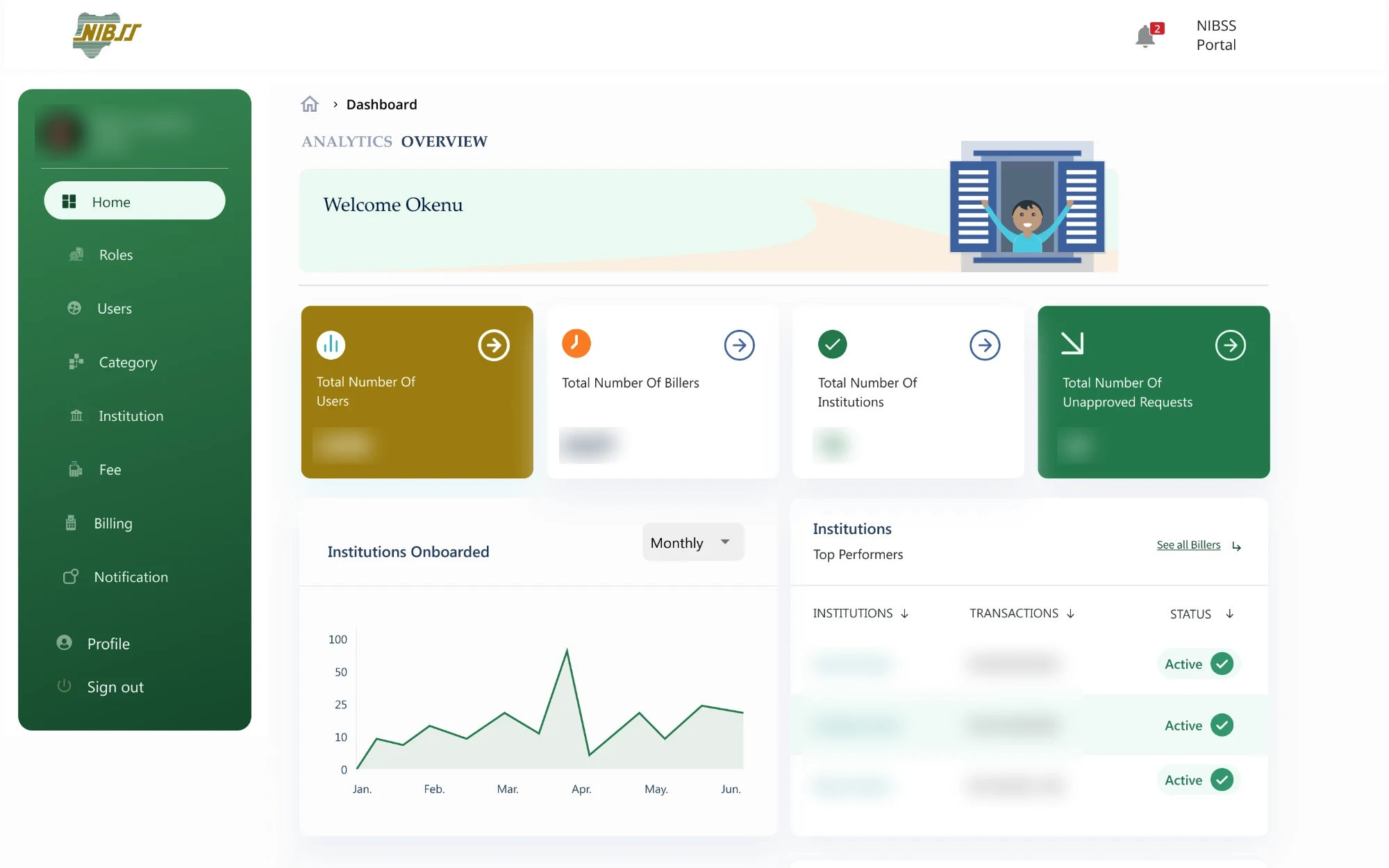
E-Bills dashboard for NIBSS showing users, billers, institutions and unapproved requests, with names and figures blurred
The problem
Paying a bill at a bank meant each bank setting up each biller its own way. NIBSS needed one shared platform where any bank could onboard billers, so tellers anywhere in the country could settle a customer’s bill quickly, and so other apps could plug in to sell the same bills.
What I did
As one of five designers, I designed portals for 19 user roles across NIBSS, banks and billers: onboarding, products and fees, approvals, transactions and disputes. I worked directly with our NIBSS contact and staff at key banks to get the rules and documentation right, and visited bank branches to see how tellers handled bills at the time.
The result
The platform is used by banks and other financial institutions across Nigeria. NIBSS reported 1.1 million e-BillsPay transactions worth ₦2.2 trillion in 2021.
paid through e-BillsPay in 2021 (NIBSS fact sheet)
₦2.2tn
transactions that year
1.1M
tiers on one platform: NIBSS, banks, billers
3
user roles, each with its own view
19
Company
At SBSC, for NIBSS (Nigeria Inter-Bank Settlement System)
Role
Senior UX/UI Designer
Team
5 designers led by Samuel Olumoyeke, with business analysts and engineers
Platform
Enterprise web application
Timeline
2020 to 2021

Problem & context

Every bank and every biller needed to meet in one place.

NIBSS runs the shared payment infrastructure for Nigeria’s banks. E-Bills is its bill payment service: a customer walks into a branch, or opens their bank’s app, and pays for something like a TV subscription, electricity or a tax bill.

For that to work everywhere, there had to be one aggregate platform. A bank needs to set up a biller once, with its products and fees. A teller in any branch needs to find that biller and settle the bill in a few steps. The biller needs to see the money arrive and raise a dispute when it doesn’t. And NIBSS needs to oversee all of it.

There was a second need alongside the portals: APIs, so that merchant and fintech apps could plug in and let their own customers pay the same bills.

Constraints

  • Client work under NDA: names, account numbers, fees and figures in the screens are blurred
  • A regulated environment where most changes need a second person’s approval
  • Many organisations, each with its own staff, branches and permissions
  • This case study shows a sample of the screens, not the whole system

Role & team

Five designers, and a lot of conversations with the people who would use it.

  • That’s me

    Chukwuemeka Iheonye

    Senior UX/UI Designer

    Design across the portals, and working directly with our NIBSS contact and staff at key banks to gather requirements and documentation.

  • Samuel Olumoyeke

    Lead Designer

    Design direction across the product.

  • Design

    3 Product Designers

    The rest of the portals.

  • Business analysis

    Business analysts

    Led most of the research and requirements.

  • Client and partners

    NIBSS and bank staff

    Rules, existing processes and review of the designs.

Research & insights

The hard part wasn’t the screens. It was learning the rules.

Our business analysts led most of the research. I worked alongside them with NIBSS staff and bank staff to understand what each group needed, how bill payments were handled at the time, and whether what we were building solved their problem. I also went into some banks to watch how tellers were already settling bills for customers.

  1. 01

    Three organisations, one flow

    A single bill payment touches NIBSS, a bank and a biller. Each one needed to see its own part without seeing the others’.

  2. 02

    Checks and balances come first

    In financial institutions, nothing goes live on one person’s say-so. One person sets something up, and another approves it.

  3. 03

    A very large number of users

    Staff at NIBSS, at every bank and branch, and at every biller all use the same system, in very different jobs.

  4. 04

    The rules already existed

    Fees, settlement and limits follow rules that NIBSS sets. The design had to make those rules visible instead of leaving people to remember them.

  5. 05

    Tellers need speed

    At the counter there is a customer waiting, so setup happens once, in advance, and paying stays short.

Process

Understand the rules, map the roles, then design each role’s view.

  1. 01

    Learn

    Sessions with our NIBSS contact and bank staff, the documentation they shared, and visits to bank branches to watch tellers at work.

  2. 02

    Map

    Who does what at each level, what needs approval, and what each role should and shouldn’t see.

  3. 03

    Design

    A shared layout and components across every portal, so a person moving between roles finds things in the same place.

  4. 04

    Review

    Designs went back to NIBSS and the banks to check them against how the work is really done.

Key decisions

Four decisions that shaped the system.

  1. Decision 01

    One platform in three tiers

    NIBSS, banks and billers all take part in a bill payment, but they have different jobs and must not see each other’s data.

    What we chose
    Each tier sets up the one below it. NIBSS onboards institutions, banks onboard billers and their products, and billers manage their own users.
    Why
    Setup follows the real chain of responsibility, and each organisation only ever sees its own part.
  2. Decision 02

    A second person approves every setup

    A wrong settlement account or fee on a biller affects real money.

    What we chose
    A creator and approver pair at the bank, and an initiator and authoriser pair at the biller. Every request records who made it, who decided, and when. A rejection carries a reason and can be sent back for another look.
    Why
    It matches how banks already control risk, and it leaves a clear trail when something is questioned later.
    The trade-off
    Setup takes longer than it would with a single step. For this kind of product that is the right cost.
  3. Decision 03

    Nineteen roles, each with its own menu

    The system has a very large number of users doing very different jobs, and financial institutions need checks and balances between them. Showing everyone everything would bury a teller’s or a biller’s daily task, and would let one person do too much.

    What we chose
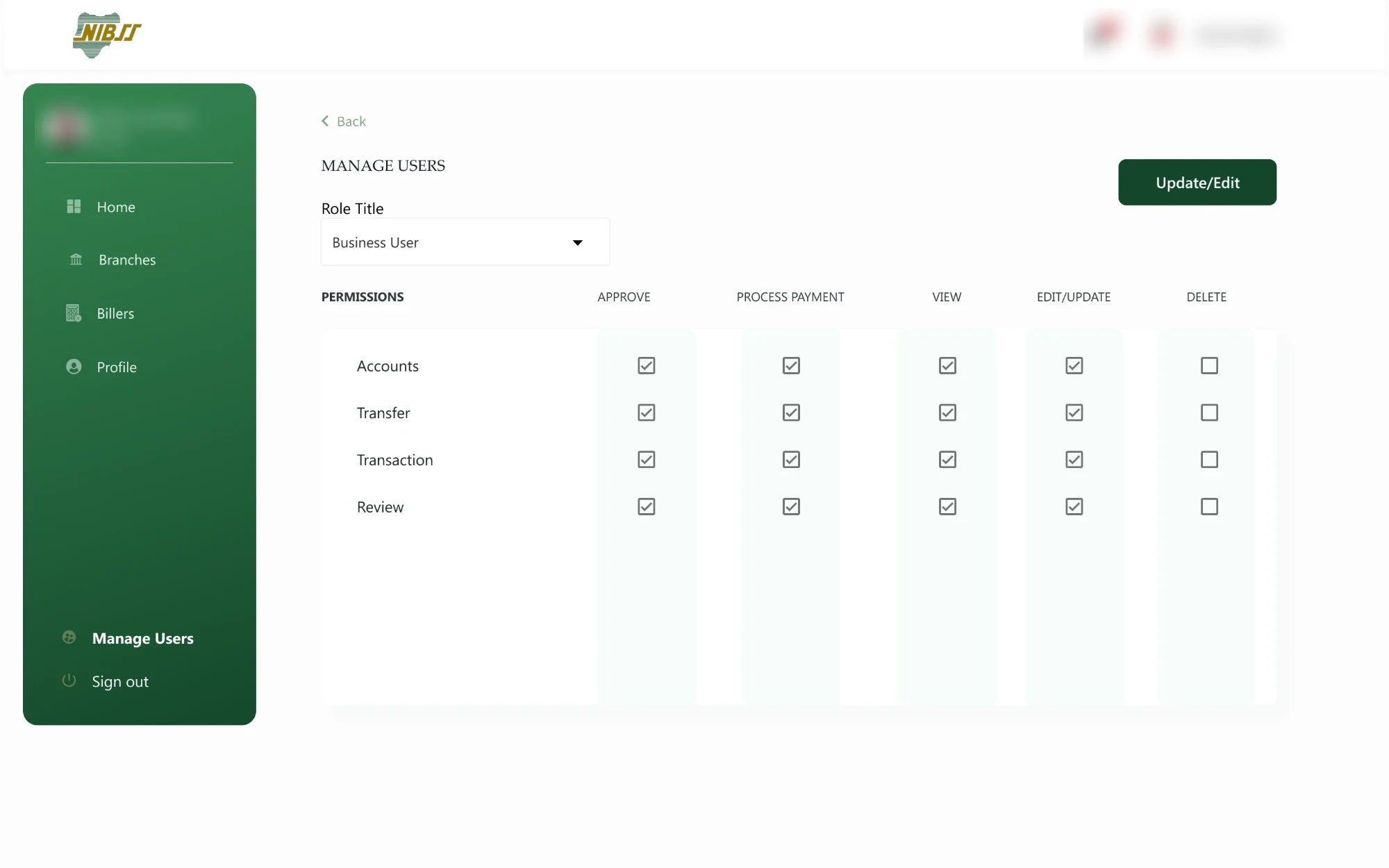
    Nineteen roles: three at the biller, nine at the bank and seven at NIBSS, most of them in creator and approver pairs. A branch creator has a branch approver, a payment teller has a payment approver, and so on up to NIBSS. The menu changes by role, and admins set what each role may do in a simple grid.
    Why
    Nobody can both make and approve the same change, people learn one short menu, and there is less they can do by mistake.
  4. Decision 04

    Put the rule next to the field

    Fees and limits follow rules set by NIBSS, and getting them wrong means a rejected request.

    What we chose
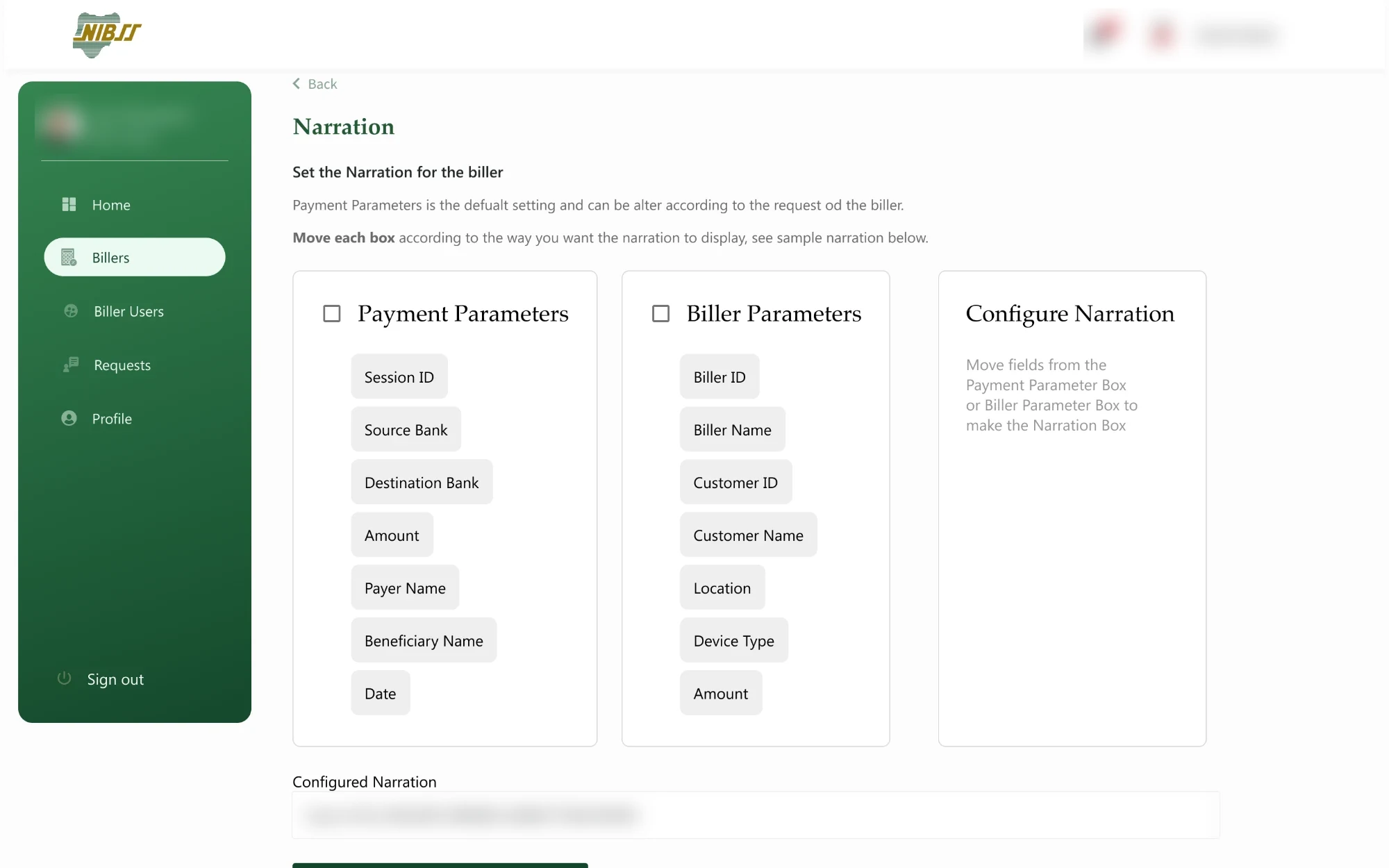
    The allowed range sits beside the fee field. Choosing an option switches off anything that no longer applies. A bank can arrange the details that appear in a payment’s description and see a sample before saving.
    Why
    People get it right the first time, so fewer requests bounce back from the approver.

Web

A sample of the screens, from the top of the system down.

Sensitive details are blurred. The layout, structure and wording are as designed.

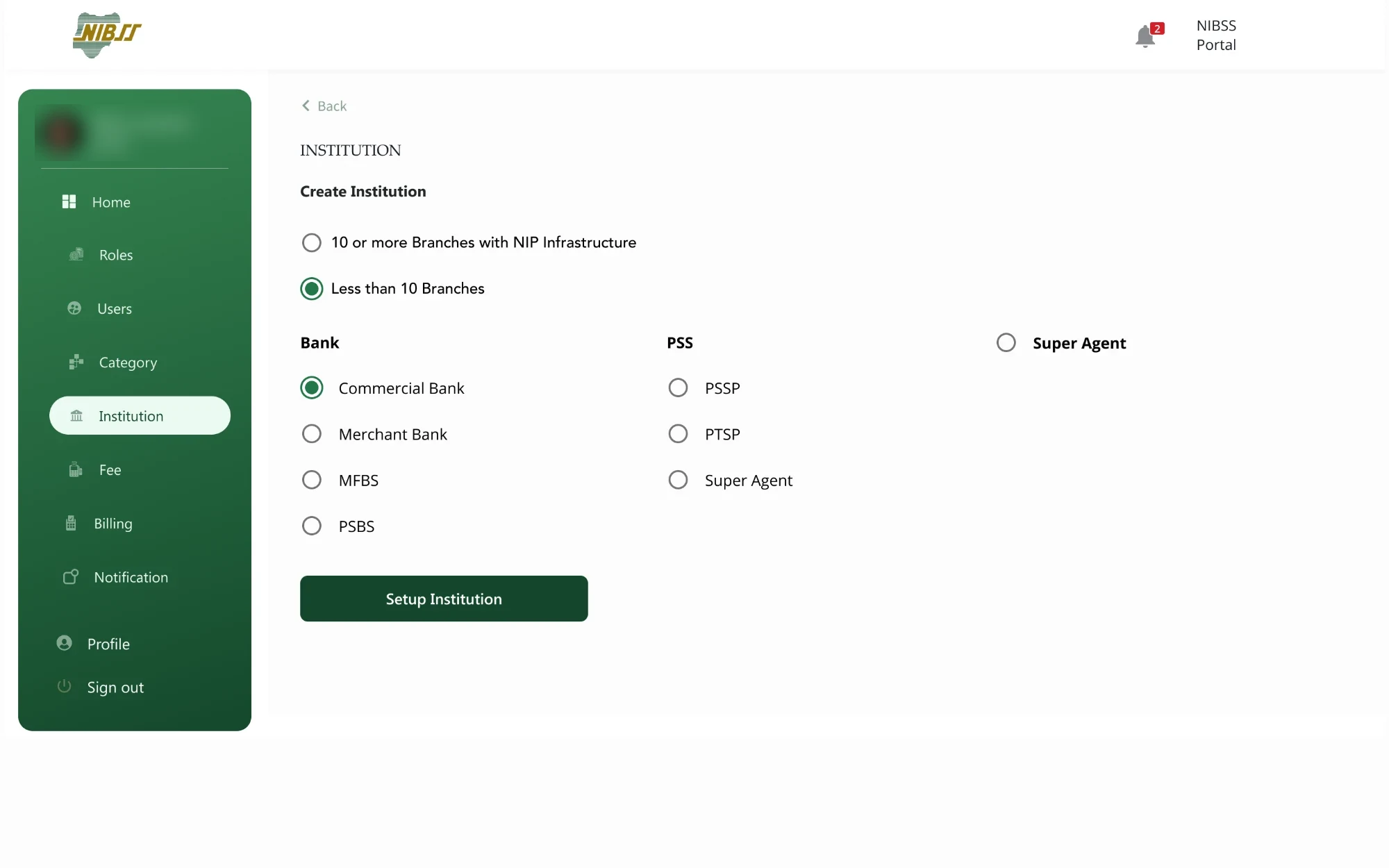
NIBSS admin choosing the type of institution to create: bank types, payment service providers or super agent
NIBSS: choosing the kind of institution to onboard.
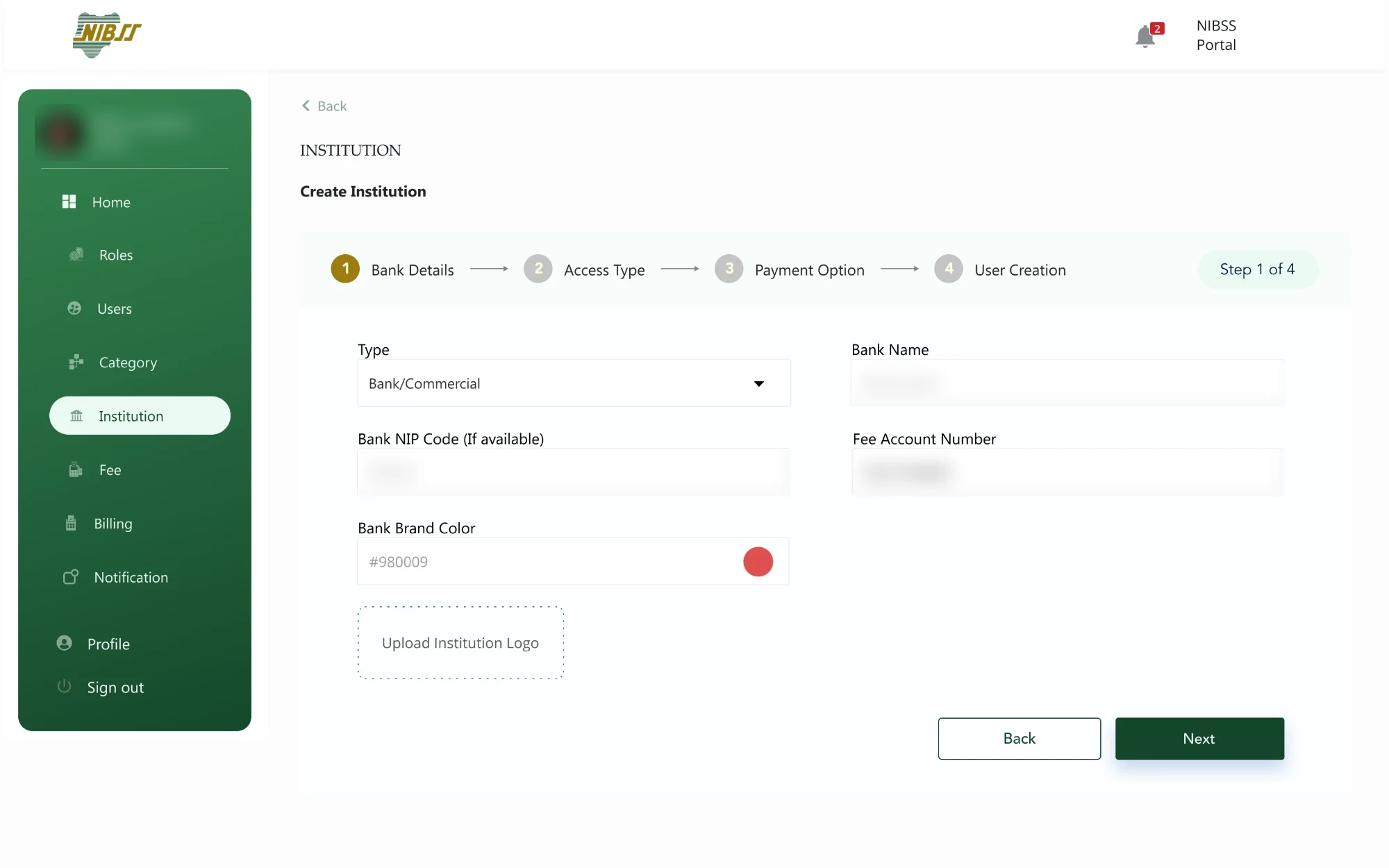
Step 1 of 4 in creating an institution, with bank details blurred
NIBSS: a long setup split into four steps.
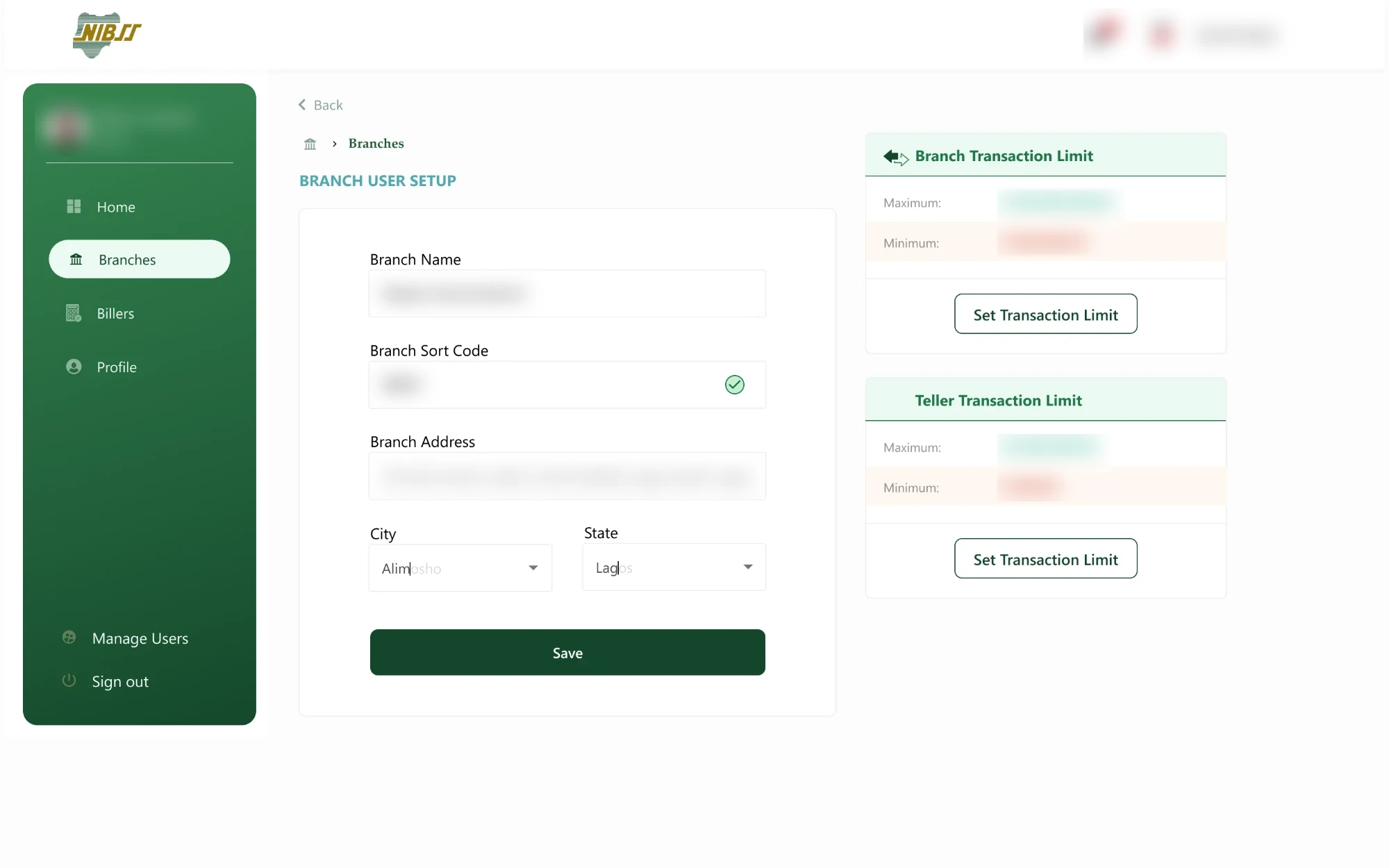
Bank admin setting up a branch with separate transaction limits for the branch and for tellers, values blurred
Bank: branch setup, with limits for the branch and its tellers.
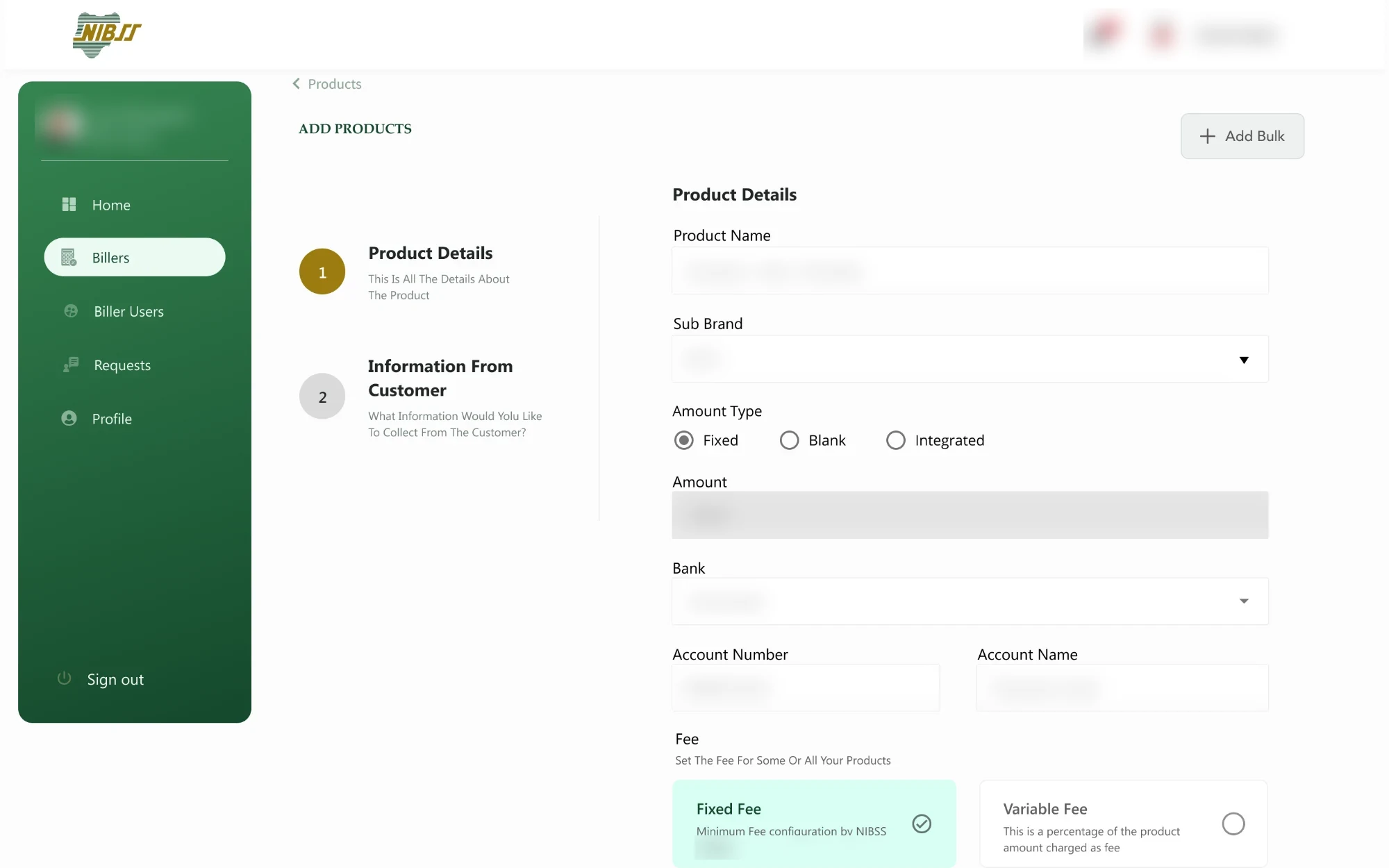
Bank user adding a biller’s product with amount type and fee options, details blurred
Bank: adding a biller’s product and its fee.
Narration screen where payment and biller details are arranged into the order they appear in a payment description
Bank: arranging what appears in a payment’s description.
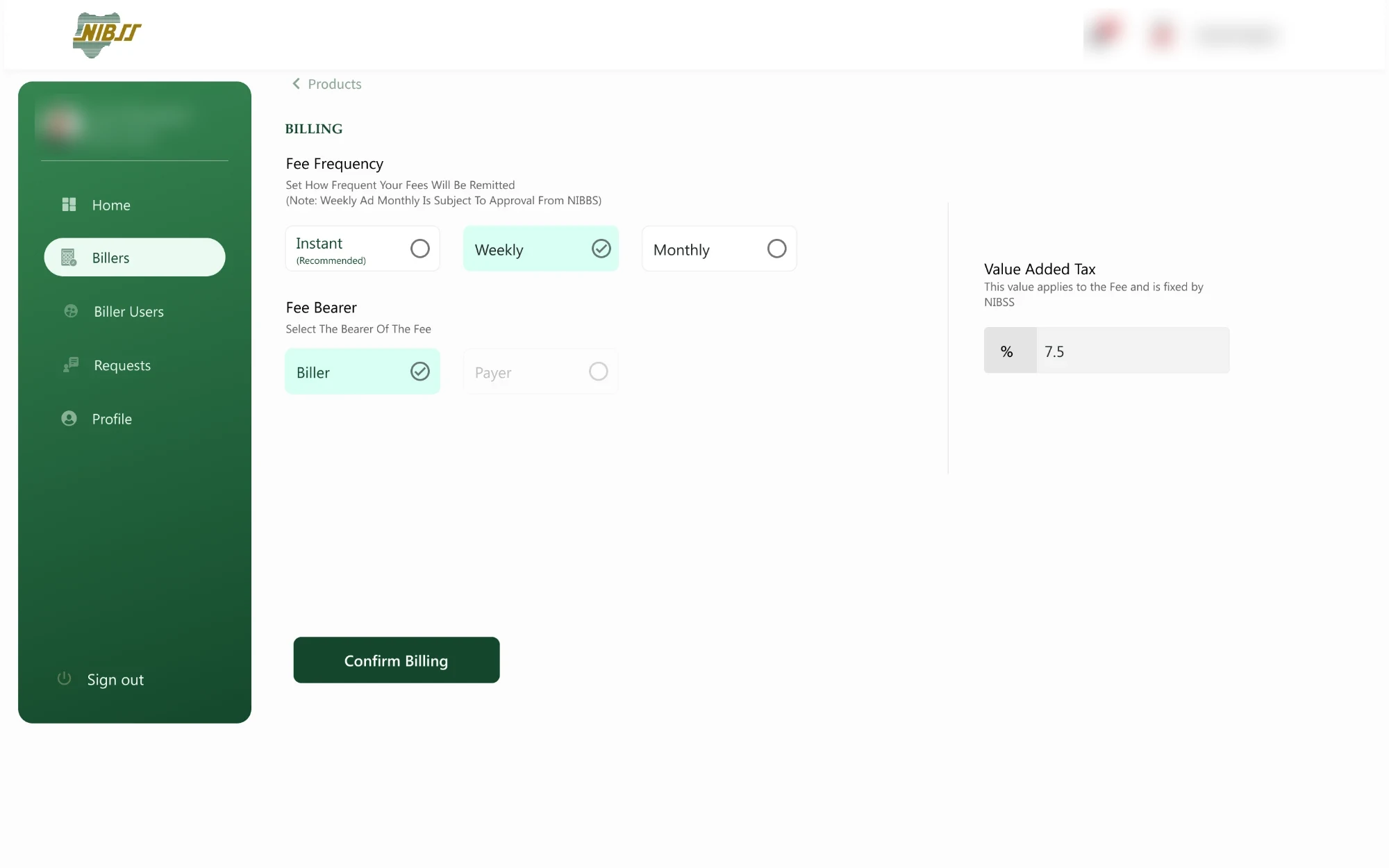
Billing screen with fee frequency and fee bearer; choosing weekly disables the payer option
Bank: one choice switches off options that no longer apply.
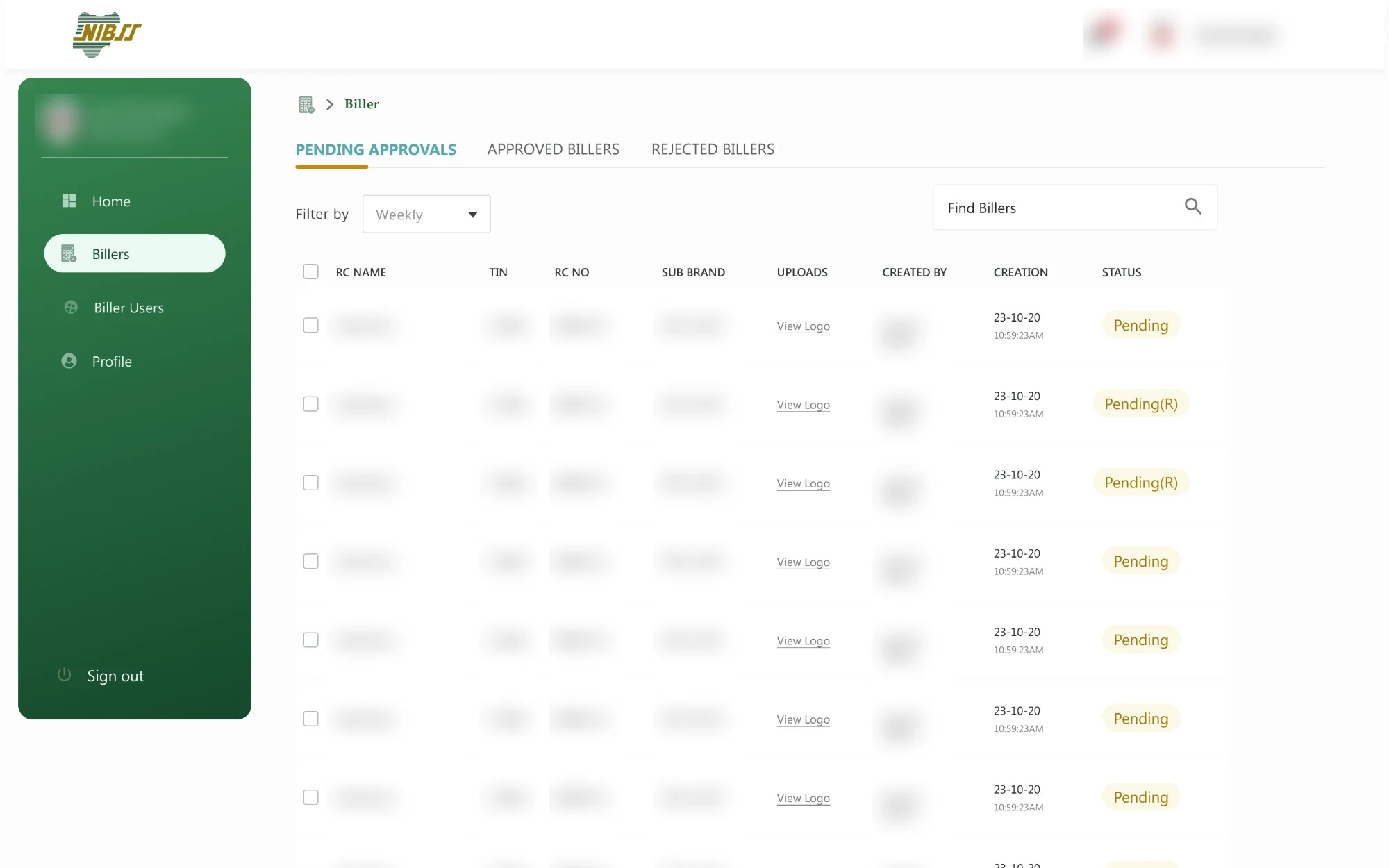
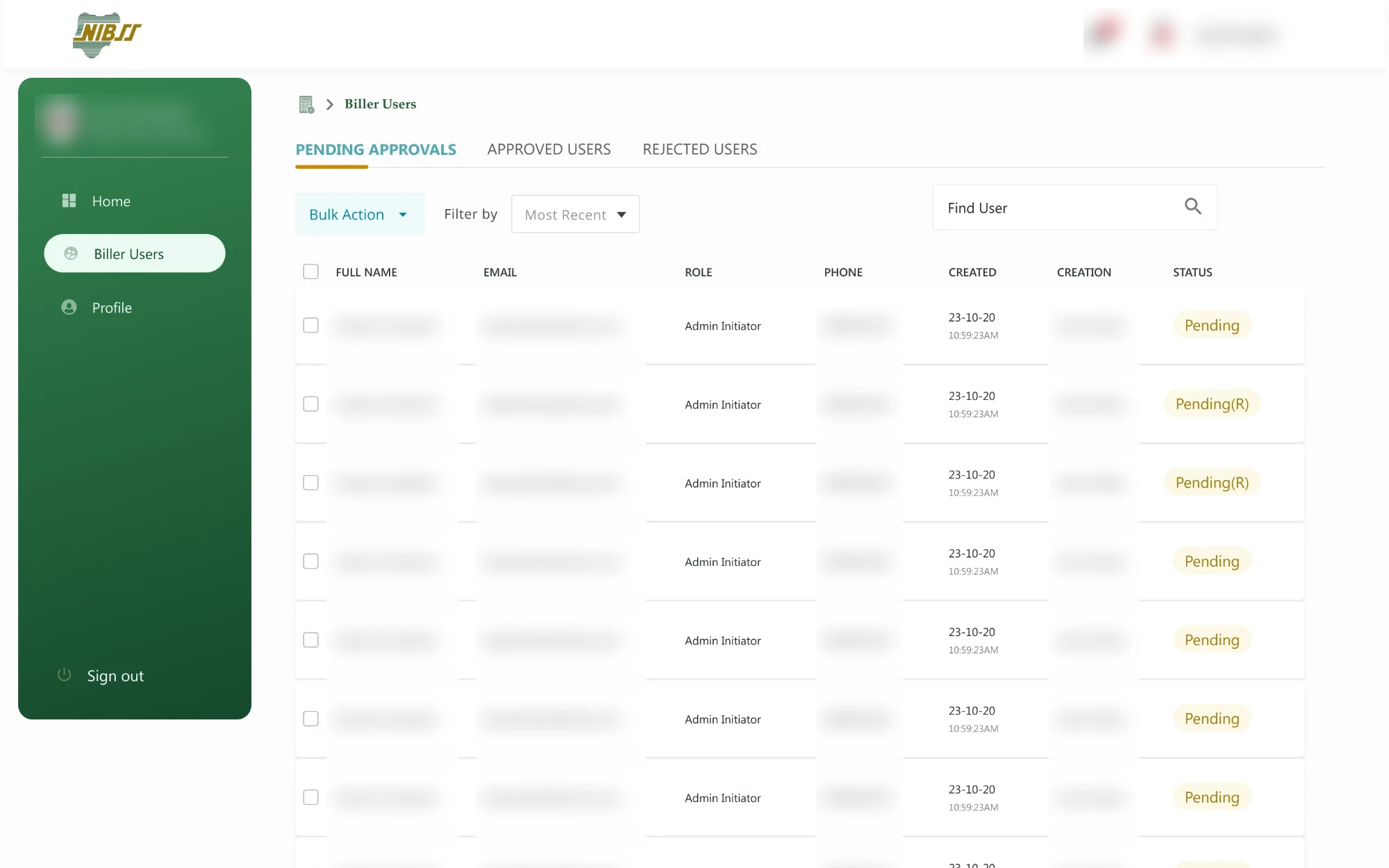
Approver’s list of billers awaiting approval, with names and numbers blurred
Bank: the approver’s queue, with resubmitted requests marked.
Permissions grid showing what a role can approve, process, view, edit and delete
Bank: what each role may do, in one grid.
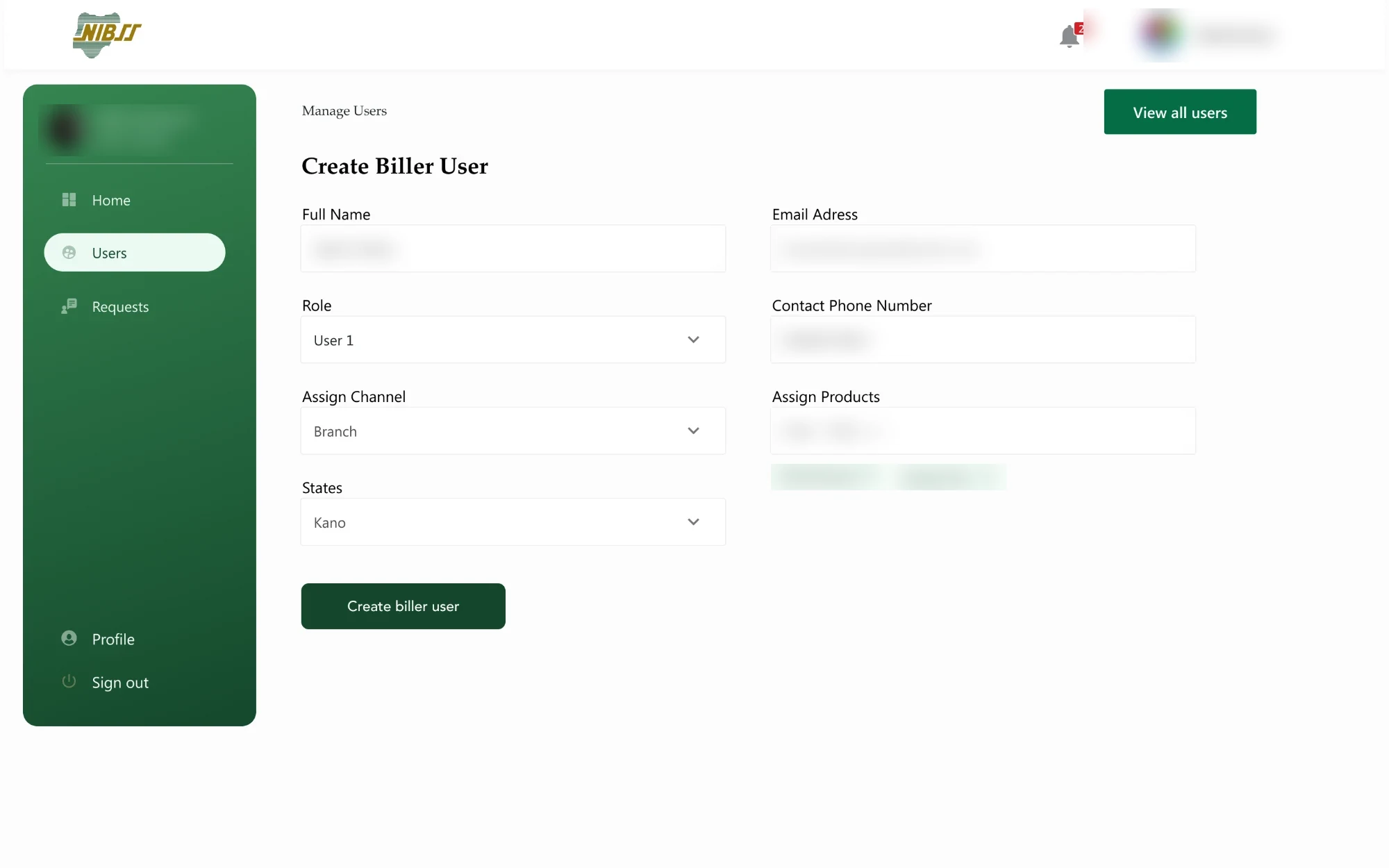
Biller admin creating a user with a role, channel, state and assigned products, details blurred
Biller: creating a user, who then needs approval.
Biller authoriser’s list of users pending approval, with names blurred
Biller: the authoriser approves or rejects.

Outcomes

One platform that the country’s banks share.

  • Used by banks and other financial institutions across Nigeria to onboard billers and take bill payments
  • NIBSS reported 1.1 million e-BillsPay transactions worth ₦2.2 trillion in 2021 (NIBSS e-Payments Fact Sheet, January to December 2021)
  • Bills can be paid at bank branches, in internet and mobile banking, by USSD and through agents
  • Nineteen user roles across NIBSS, banks and billers, with approvals and a record of who did what at every level
  • APIs so merchant and fintech apps can let their own customers pay the same bills

Reflection & next

On enterprise products, the design work is mostly understanding.

  1. 01Most of my time went into learning how banks and NIBSS already worked. The screens came easily once the rules were clear.
  2. 02Working directly with the people who would use it, and not only through documents, caught misunderstandings early.
  3. 03A consistent layout across portals mattered more than any single screen, because the same people move between roles.

Coming next

What I’d do differently

I’d go back to the same bank branches with the designs in hand. I watched how tellers worked before we started, and we reviewed designs with NIBSS and the banks, but watching a teller complete a task on the new screens would have told us more than a review meeting.